
Home Gym vs Commercial Gym Equipment: Differences, Benefits and What to Choose
The distinction between home and commercial gym equipment is not simply a marketing category. It describes a genuine difference in how equipment is engineered, how long it is expected to last and how many people it is built to serve. Understanding that difference before you buy saves you from either overspending on commercial-grade hardware you will never fully use, or underbuying equipment that wears out faster than expected because the use case was underestimated.
This guide covers what separates the two categories, who each one suits and how to make the right call whether you are fitting out a home, a personal training studio or a small commercial facility.
What Actually Separates Home and Commercial Gym Equipment
The most meaningful differences between home and commercial equipment are steel gauge, duty cycle and warranty scope. These three things are more informative than price alone when comparing two pieces of equipment that appear similar on the surface.
Steel gauge refers to the thickness of the steel used in the frame. Commercial equipment uses heavier steel, typically 11-gauge (3mm) or thicker, which makes frames more rigid under repeated heavy loading. Home equipment often uses 14-gauge (2mm) steel, which is adequate for one or two users training several times a week but will show wear faster under the kind of volume a training facility generates.
Duty cycle describes how frequently the equipment is designed to be used. Commercial equipment is rated for multiple users across multiple sessions daily, often running eight to twelve hours of use per day continuously. Home equipment is typically rated for two to four users at standard training frequency. This matters not just for durability but for components like weight stacks, cable systems and pulley bearings, which wear differently under sustained commercial demand.
Warranty scope reflects the manufacturer's confidence in how the product will perform. Commercial equipment typically carries separate warranties for the frame, moving parts and upholstery, with longer structural coverage. Home equipment warranties are usually shorter across the board. A longer warranty on a piece of equipment is one of the more reliable signals of build quality between two otherwise similar-looking products.
Who Commercial Equipment Is Actually For
Commercial gym equipment makes financial and practical sense in three situations. The first is a professional setting, a gym, a personal training studio, a physiotherapy clinic or a corporate wellness facility, where equipment will be used by multiple different people across different times of day with no predictable limit on frequency. The second is a home gym shared by four or more regular users who all train at high intensity and frequency. The third is a buyer who plans to train hard for many years without replacing equipment, and for whom the higher upfront cost is a deliberate investment in longevity rather than a concession to marketing.
For a solo home user or a couple training three to five times a week at normal intensity, quality home-grade equipment from a reputable brand is the more rational choice. It costs less, takes up comparable space and will last well beyond its investment horizon when used within its rated parameters.
Functional Trainers: Home Grade vs Commercial Grade
The functional trainer category illustrates the home versus commercial distinction particularly clearly because both types look similar from a distance but differ substantially in cable system quality, pulley grade and weight stack construction.
A home-grade functional trainer uses cables and pulleys rated for individual training sessions rather than continuous back-to-back use. The weight stacks are typically pin-loaded and sized for a single user's working range. The cable routing and bearing quality reflects an expectation of moderate use rather than all-day operation.
A commercial functional trainer such as the Bodycraft LCFTG and LHFTG uses heavier cables, commercial-grade sealed bearings and a frame designed to handle the cumulative load of many different users with different strength levels and training styles across a full working day. The smooth, consistent feel of the cable across the full range of motion in a well-made commercial trainer is genuinely different from an equivalent home unit, and that difference becomes more noticeable when the trainer is under sustained use.
Multi-Station Gyms for Commercial Settings
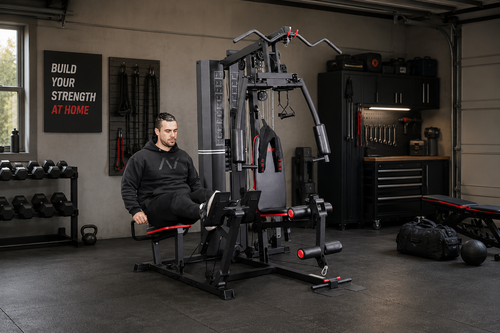
A commercial multi-station gym serves a specific purpose that a functional trainer does not: it lets multiple people work on different exercises simultaneously from one frame without interfering with each other. In a small PT studio or commercial setting where two or three clients might be training at overlapping times, this is a practical operational advantage beyond the training versatility the machine provides on its own.
Commercial multi-station gyms are also built with user interchangeability in mind, meaning seat adjustments, pin loads and cable positions are designed to accommodate a wider range of body types and strength levels than home units which are often configured around a narrower user profile.
Conditioning Equipment for Studios and Facilities
Strength machines are not the whole picture for a PT studio or functional training space. Conditioning accessories that require no electrical components and minimal maintenance are some of the most cost-effective and durable equipment a facility can buy, and they add a dimension of cardiovascular and metabolic training that cable machines alone do not cover.
Battle ropes are a good example. A 15-metre heavy rope requires no maintenance, has no moving parts and generates high-intensity upper-body and cardiovascular demand that is difficult to replicate with weight stack equipment. They work for individual sessions, partner training and group conditioning circuits, and they last for years under heavy use. In a studio setting, they earn their floor space many times over.
Parallette bars are another low-footprint, high-utility option. They support L-sits, push-up variations, dip progressions and handstand work, and they can be moved, stacked and stored easily between sessions. For a personal training studio where space shifts between uses, portable equipment like this has practical value beyond its training applications.
Choosing Between a Functional Trainer and a Multi-Station Gym
This is one of the most common decision points for people fitting out a studio or a serious home gym, and the right answer genuinely depends on your specific situation rather than one being objectively better.
A functional trainer uses independently adjustable pulleys that move through a full height range, which means cable angles can be set precisely for any exercise rather than being fixed at the positions built into a station. This makes it more adaptable for personalised programming, rehabilitation work and movements that need a specific cable angle. The trade-off is that it is primarily a cable machine, and while a good functional trainer covers a very wide exercise range, it works best alongside free weights rather than as a complete standalone solution.
A multi-station gym provides dedicated fixed stations for each major movement pattern. This makes it faster to move between exercises, easier for a variety of users to operate without extensive instruction, and more self-contained as a single-purchase solution. The trade-off is less flexibility in cable angle and exercise variation compared to a functional trainer with adjustable pulleys.
For a PT studio with space for only one larger piece of equipment and a client base with varied training backgrounds, a commercial functional trainer is usually the more versatile long-term choice. For a small gym or facility where multiple users will move through independently and speed of changeover between exercises matters, a multi-station gym is often the more practical option.
What to Check Before Buying Commercial Equipment
The checklist for commercial equipment purchases is longer than for home equipment, and for good reason. Getting it wrong in a commercial setting affects not just your investment but the experience and safety of everyone who uses the space.
For any large commercial piece, confirm the floor load rating of your space and cross-check it against the equipment weight plus likely plate loading. Check the bolt pattern and footprint against your actual floor area, not just a rough estimate. Confirm ceiling height against the frame height plus any overhead clearance requirements for pull-up work. Check what installation support the supplier offers and whether assembly is included or an additional cost.
For warranty and service, confirm who handles parts replacement and whether on-site servicing is available in your area. For a piece of equipment in active commercial use, the ability to get a cable replaced or a bearing serviced quickly matters more than almost any other post-purchase consideration.
World Fitness Australia's Cheltenham showroom carries a range of commercial equipment that can be inspected in person before purchase, which is particularly worthwhile for commercial buyers who are making decisions about equipment that will be in regular use for many years. The team can also advise on installation, warranty terms and service options for specific models.
Frequently Asked Questions
What is the difference between home and commercial gym equipment?
Commercial equipment is generally built to a heavier steel gauge, higher duty cycle and longer warranty than home-grade equipment, reflecting the demands of multiple users in a professional setting. Check each product's specifications, rated capacity and warranty terms to confirm whether it suits your setting rather than relying on the product category label alone.
Is commercial gym equipment worth buying for a home gym?
It can be worthwhile for frequent training or a household with several regular users, provided the equipment fits the available space and budget. For a solo home user at standard training frequency, quality home-grade equipment from a reputable brand is typically the more rational investment.
What is a commercial functional trainer used for?
A functional trainer uses adjustable cable pulleys to cover pressing, pulling, rotational and rehabilitation movements at any cable angle, supporting a wide range of personalised strength and conditioning sessions from a single frame.
What should you look for when buying a commercial half rack?
Review frame gauge and construction, rated load capacity, pull-up bar load rating, the number and spacing of J-hook positions, compatibility with safety arms and additional attachments, and whether the footprint suits your floor plan.
Can commercial gym equipment be installed in a garage or studio?
It can be suitable if the space has adequate ceiling height, floor load capacity and clearance around the equipment. Check manufacturer dimensions, installation requirements and access for delivery before purchasing, since commercial equipment is heavier and more complex to position than home-grade alternatives.
What gym equipment is useful for a personal training studio?
Commercial functional trainers, racks and conditioning accessories such as battle ropes and parallettes support a wide variety of client sessions in a compact footprint. Choose based on the range of clients you serve, the space available and the expected weekly use volume rather than buying for a single training style.
What is a battle rope used for in a gym?
Battle ropes are used for conditioning intervals and exercises that develop grip strength, shoulder endurance and cardiovascular capacity, and they integrate into individual sessions, partner training and group conditioning circuits without requiring electrical power or ongoing maintenance.
How do you choose between a functional trainer and a multi-station gym?
A functional trainer with independently adjustable pulleys offers more precise cable angle control and suits varied personalised programming, while a multi-station gym provides dedicated fixed stations that are faster to move between and easier for a range of users to operate without instruction. Compare the exercise range each provides, the footprint, and which better matches how your space will actually be used day to day.
Cheltenham VIC ☎ Real questions, real people
(03) 9583 7820 Contact our team →
Leave a comment