
Functional Trainer Exercises: Full-Body Workouts You Can Do on One Machine
A functional trainer covers chest press, seated row, lat pulldown, cable crossover, shoulder press, tricep pushdown, bicep curl and core rotation exercises, with the exact list depending on the attachments included.
That range is wide enough to build a genuine full-body routine around one machine, which is the main reason a home gym functional trainer suits people who want real training variety without a room full of separate equipment.
This guide walks through the exercises a functional trainer actually supports, grouped by movement pattern, then puts them together into a full-body session structure, plus what to know before your first workout.
Is an All-in-One Gym Trainer a True Full-Body Workout Machine?
Yes, within the limits of cable-based resistance. An all-in-one gym trainer's two independent pulleys cover pushing, pulling and core movements across every major muscle group, which is what makes it a genuine full body workout machine rather than a machine built around one or two exercises. The main gap is heavy compound barbell lifts like a back squat or deadlift, which a cable-only functional trainer doesn't replicate directly, covered in more detail below.

Push Exercises on a Functional Trainer
- Cable chest press. Set both pulleys to chest height, press forward and together, targeting the chest, shoulders and triceps.
- Cable shoulder press. Pulleys set low, press upward from shoulder height, targeting the deltoids and triceps.
- Cable crossover. Pulleys set high, bring the handles down and across the body, isolating the chest through a longer range of motion than a flat press.
- Tricep pushdown. Pulley set high with a straight bar or rope attachment, pushing down to isolate the triceps.

Pull Exercises on a Functional Trainer
- Seated cable row. Pulleys set low, pull the handles toward the torso, targeting the mid-back and biceps.
- Lat pulldown. Pulleys set high with a bar attachment, pulling down toward the chest, targeting the lats and upper back.
- Cable bicep curl. Pulley set low, curling the handle upward, isolating the biceps.
- Face pull. Pulley set at head height with a rope attachment, pulling toward the face, targeting the rear shoulders and upper back.

Core and Rotational Exercises
- Standing cable core rotation. Pulley set at chest height, rotating the torso against resistance, targeting the obliques.
- Standing cable crunch. Pulley set high with a rope attachment, crunching downward against resistance, targeting the abdominals.
- Cable woodchopper. Pulley set high or low, pulling diagonally across the body, combining core rotation with a functional movement pattern.
Can I Do Squats on a Functional Trainer?
A functional trainer with a built in Smith bar allows guided squats, using the same fixed vertical bar path a standalone Smith machine offers. A cable only functional trainer without a Smith bar can still be used for cable squats or leg press style movements using the pulleys, though it won't replicate a loaded barbell squat directly. If squats are a priority in your programming, a combo unit is worth prioritising over a cable-only model, and we've covered that comparison in full in our guide to functional trainers, Smith machines and multi-station gyms.

A Full-Body Functional Trainer Workout Structure
A straightforward way to structure a complete session using only a functional trainer:
- Cable chest press, 3 to 4 sets, for chest, shoulders and triceps.
- Seated cable row, 3 to 4 sets, for back and biceps.
- Lat pulldown, 3 sets, for upper back and lats.
- Cable shoulder press, 3 sets, for shoulders and triceps.
- Cable bicep curl and tricep pushdown, 2 to 3 sets each, for arm isolation.
- Standing cable core rotation, 2 to 3 sets per side, to finish.
This covers every major upper body muscle group and the core in one session using a single machine. Readers wanting guided barbell squats and presses as well should look at a combo unit with a built in Smith bar rather than relying on cable-only leg work.
Getting Started Safely
Start with a light weight stack setting to learn the cable path and pulley range of motion before increasing resistance, and check that each attachment is securely locked before every exercise. The guided cable path makes it straightforward for beginners to follow a structured push, pull and core routine safely, since the resistance simply goes slack if you let go of the handle rather than a bar landing on you.
How Often Should You Train on a Functional Trainer?
Training frequency depends on your program and recovery, though most home users train three to five sessions a week using a functional trainer as part of a broader routine. Beginners often start with two to three full-body sessions a week, adding frequency as recovery allows.
Do You Need Other Equipment Too?
A functional trainer covers most strength training needs on its own, though many users add a bench, resistance bands or free weights for additional variety over time. A bench in particular expands the exercise list further, adding flat, incline and decline pressing variations to the cable movements above.
Common Mistakes When Training on a Functional Trainer
- Starting with too much resistance. Learning the cable path and range of motion at a lighter weight first reduces injury risk and improves technique once you do add load.
- Not checking attachment security before each exercise. A loose carabiner or clip is an easily avoidable but genuine safety risk.
- Relying only on cable-only leg work if squats are a real priority. A combo unit with a Smith bar is a better fit for anyone who wants guided barbell squats specifically.
- Repeating the same few exercises. The attachment system supports far more variety than most users actually use, worth rotating through push, pull and core movements each week.
Where to Start
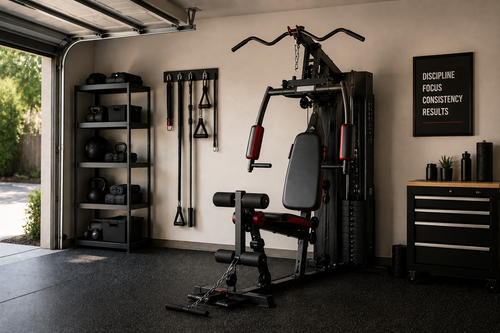
Three functional trainers suited to building the full-body routine above, from a compact entry unit through to a combo frame with a built-in Smith bar.
Frequently Asked Questions
Q. What exercises can I do on an all-in-one functional trainer?
A. A functional trainer covers chest press, seated row, lat pulldown, cable crossover, shoulder press, tricep pushdown, bicep curl and core rotation exercises, with the exact list depending on the attachments included.
Q. Can I do a full-body workout on one functional trainer?
A. Yes, a functional trainer's dual cable system covers pushing, pulling and core movements across a full session, making it possible to train the whole body on one machine.
Q. What is the safest way to start using a functional trainer?
A. Start with a light weight stack setting to learn the cable path and pulley range of motion before increasing resistance, and check that each attachment is securely locked before every exercise.
Q. Can I do squats on a functional trainer?
A. A functional trainer with a built in Smith bar allows guided squats, while a cable only functional trainer can be used for cable squats or leg press style movements depending on the attachments included.
Q. What is the difference between a cable chest press and a free weight bench press?
A. A cable chest press on a functional trainer follows a guided but adjustable path and keeps tension on the muscle throughout the movement, while a free weight bench press requires more stabiliser muscle engagement and a spotter for heavier loads.
Q. How often should I train on a functional trainer each week?
A. Training frequency depends on your program and recovery, though most home users train three to five sessions a week using a functional trainer as part of a broader routine.
Q. Can beginners follow a structured workout on a functional trainer?
A. Yes, the guided cable path makes it straightforward for beginners to follow a structured push, pull and core routine safely.
Q. Do I need additional equipment alongside a functional trainer for a complete workout?
A. A functional trainer covers most strength training needs on its own, though many users add a bench, resistance bands or free weights for additional variety over time.
Contact us for current offers, discounts and pricing.
Leave a comment