
10 Functional Trainer Exercises for Your Home Gym
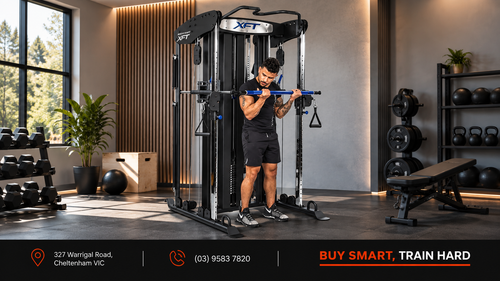
If you want to build a versatile home gym without filling it with a separate machine for every muscle group, a functional trainer is one of the most useful pieces of strength equipment you can own.
With adjustable cable pulleys, multiple attachment options and resistance that can be positioned at different heights, a functional trainer gives you plenty of options for training your upper body, lower body and core from one station.
By simply changing the pulley height or swapping attachments, you can move from chest presses and rows to lateral raises, lower-body exercises, arm exercises and core work without jumping between several different machines.
Not sure where to begin?
Here are 10 functional trainer exercises you can add to your home gym workouts.
What Is a Functional Trainer?
A functional trainer is a cable-based strength training machine that typically uses adjustable pulleys connected to weight stacks.
Unlike many fixed-path strength machines, adjustable cables give you greater freedom over the direction and angle of resistance, opening up a wide variety of compound and isolation exercises.
The BodyIron BFX250 Commercial Functional Trainer, for example, features two independently adjustable cable columns with 31 height positions and 180-degree rotation.
It comes standard with two 60kg weight stacks and includes:
- 1 x Long bar
- 1 x Short bar
- 1 x Tricep rope
- 1 x Multi-grip chin-up bar (built in)
- 1 x Nylon strap
- 1 x Ankle strap
- 2 x Single handles
That gives you plenty of options for changing exercises, grips and cable positions from the same machine.
So, what exercises can you do?
1. Cable Chest Press

Targets: Chest, shoulders and triceps
Attachment: Two single handles
The cable chest press is a compound upper-body exercise that provides an alternative to traditional dumbbell or barbell pressing.
How to do it:
- Position both pulleys around chest height.
- Attach a single handle to each cable.
- Stand between the cable columns facing away from the machine.
- Hold a handle in each hand with your elbows bent.
- Take a staggered stance and brace your core.
- Press both handles forward until your arms are extended.
- Slowly return to the starting position under control.
Keep your chest up and maintain control as you return rather than allowing the weight stacks to pull your arms backwards.
Try: 3 sets of 8–12 reps.
2. High-to-Low Cable Chest Fly

Targets: Chest and front shoulders
Attachment: Two single handles
The high-to-low cable chest fly is an effective chest isolation exercise that maintains consistent resistance throughout the movement and allows both sides of the chest to work together.
How to do it:
- Position both pulleys at a high setting.
- Attach a single handle to each cable.
- Stand in the centre facing away from the functional trainer.
- Step slightly forward and lean your torso forward for stability.
- Begin with your arms open to either side, maintaining a slight bend through your elbows.
- Pull both handles forwards and down in a controlled arc until your hands come together in front of your body.
- Squeeze your chest at the end of the movement.
- Slowly allow your arms to open back to the starting position under control.
Keep the bend in your elbows relatively consistent throughout the movement and avoid using momentum to bring the handles together.
Try: 3 sets of 10–15 reps.
3. Cable Bent-Over Row

Targets: Upper back, lats, rear shoulders and biceps
Attachment: Long bar
The cable bent-over row is a horizontal pulling exercise that helps build back strength and works the biceps, while the cable resistance keeps tension throughout the movement.
How to do it:
- Position both pulleys at the lowest setting.
- Attach each end of the long bar to a cable.
- Stand centred between the pulleys and hold the bar with an overhand grip.
- Hinge forward at the hips with a slight bend in your knees, keeping your back straight and core braced.
- Start with your arms extended towards the floor.
- Pull the bar towards your lower torso, driving your elbows backwards.
- Squeeze your shoulder blades together at the top of the movement.
- Slowly lower the bar back to the starting position under control.
Keep your torso stable throughout the exercise and avoid using momentum or rounding your back.
Try: 3 sets of 8–12 reps.
4. Cable Hip Abduction

Targets: Glutes, particularly the gluteus medius, and outer hips
Attachment: Ankle strap
The cable hip abduction is a lower-body isolation exercise that targets the outer glutes and hips while also challenging your balance and stability.
How to do it:
- Position the pulley at the lowest setting and attach the ankle strap.
- Secure the ankle strap around the ankle furthest from the pulley.
- Stand side-on to the functional trainer and hold onto the frame with your inside hand for support.
- Keep your standing leg slightly bent, brace your core and begin with your working leg close to your body.
- Keeping your working leg relatively straight, lift it out to the side and away from the machine against the cable resistance.
- Pause briefly at the top of the movement.
- Slowly lower your leg back towards the starting position under control.
- Complete your reps before turning around and repeating on the other side.
Keep your torso as stable as possible throughout the movement. Avoid leaning excessively or using momentum to swing your leg out to the side.
Try: 3 sets of 10–15 reps per side.
5. Cable Lateral Raise

Targets: Shoulders, particularly the side deltoids
Attachment: 2 × single handles
Cable lateral raises are an effective shoulder isolation exercise. Using both sides of the functional trainer allows you to train both shoulders simultaneously while maintaining consistent cable tension throughout the movement.
How to do it:
- Set both pulleys to a low position.
- Attach a single handle to each cable.
- Stand centred in front of the functional trainer, facing the machine.
- Cross the cables in front of your body, holding the left cable in your right hand and the right cable in your left hand.
- Keep your core braced and maintain a slight bend through your elbows.
- Raise both arms out to your sides until they reach approximately shoulder height.
- Pause briefly at the top while keeping your shoulders controlled.
- Slowly lower both handles back to the starting position.
Choose a manageable resistance that allows you to raise and lower the handles under control without using momentum or shrugging your shoulders.
Try: 3 sets of 10–15 reps.
6. Cable Bicep Curl

Targets: Biceps
Attachment: Single handle
The single-arm cable bicep curl is an effective isolation exercise for targeting each bicep individually while maintaining consistent tension throughout the movement.
How to do it:
- Set one pulley to a low position.
- Attach a single handle.
- Stand facing the functional trainer and hold the handle with one hand using an underhand grip.
- Keep your elbow close to your side and your upper arm relatively still.
- Curl the handle upwards towards your shoulder.
- Squeeze your bicep at the top of the movement.
- Slowly lower the handle until your arm is extended.
- Complete your reps before changing arms.
Keep your body stable and avoid swinging or using momentum to lift the weight.
Try: 3 sets of 10–15 reps per arm.
7. Rope Tricep Pushdown

Targets: Triceps
Attachment: Tricep rope
The tricep pushdown is one of the most recognisable cable exercises and makes use of the tricep rope included with the BFX250.
How to do it:
- Position one pulley high.
- Attach the tricep rope.
- Stand facing the functional trainer.
- Grip each end of the rope.
- Keep your elbows close to your sides.
- Push the rope down until your arms are extended.
- Control the resistance as you return to the starting position.
Keep your upper arms relatively still rather than allowing your elbows to swing backwards and forwards.
Try: 3 sets of 10–15 reps.
8. Overhead Tricep Extension

Targets: Triceps
Attachment: Tricep rope
The cable overhead tricep extension isolates the triceps using continuous cable resistance. Performing the movement in a bent-over position allows you to extend the rope forwards while keeping your upper arms relatively stable.
How to do it:
- Position the pulley at a high setting and attach the tricep rope.
- Stand facing away from the functional trainer and hold one end of the rope in each hand.
- Step forward and hinge your torso forwards, bringing the rope behind your head.
- Keep your elbows bent and pointing forwards, with your upper arms relatively still.
- Brace your core and extend your elbows to push the rope forwards and away from your head.
- Continue until your arms are extended.
- Pause briefly and squeeze your triceps.
- Slowly bend your elbows to return the rope behind your head under control.
Focus on creating the movement through your elbows rather than swinging your shoulders or torso, and choose a resistance that allows you to maintain a stable position.
Try: 3 sets of 10–15 reps.
9. Cable Face Pull

Targets: Rear shoulders and upper back
Attachment: Tricep rope
Face pulls are another useful exercise you can perform with the rope attachment, this time targeting the upper back and rear shoulders.
How to do it:
- Position the pulley around upper-chest to face height.
- Attach the tricep rope.
- Stand facing the machine and take hold of both ends.
- Step backwards to create tension.
- Pull the rope towards your face while allowing your elbows to move outwards.
- Squeeze through your upper back.
- Slowly extend your arms to return to the starting position.
Keep the movement controlled and choose a resistance that allows you to maintain good positioning throughout each rep.
Try: 3 sets of 10–15 reps.
10. Cable Squat

Targets: Quads, glutes, hamstrings and core
Attachment: Long bar
The cable squat is a lower-body compound exercise that uses the functional trainer’s resistance to target your legs and glutes while also challenging your core and stability.
How to do it:
- Position both pulleys at the lowest setting.
- Attach each end of the long bar to a cable.
- Position the long bar comfortably across the back of your shoulders and stand with your feet approximately shoulder-width apart.
- Keep your chest up, brace your core and maintain a neutral spine.
- Bend through your knees and hips to lower yourself into a squat.
- Continue lowering until you reach a comfortable depth while keeping your feet firmly planted.
- Push through your feet to extend your knees and hips and return to the standing position.
- Squeeze your glutes at the top before beginning the next rep.
Keep your knees tracking in line with your toes throughout the movement and avoid rounding your back as you lower into the squat.
Try: 3 sets of 8–12 reps.
Bonus: Multi-Grip Pull-Ups and Chin-Ups
Targets: Lats, upper back, biceps and core
Equipment: Built-in multi-grip chin-up bar
Cables aren't the only training option available on the BFX250.
The built-in multi-grip chin-up bar lets you add bodyweight vertical pulling exercises such as pull-ups and chin-ups to your training.
Take hold of the bar using your chosen grip, brace your body and pull yourself upwards until your chin approaches or passes the bar. Lower yourself back down under control.
If you're still building towards an unassisted pull-up, other back exercises such as cable rows and lat pulldowns can help build pulling strength.
Turn These Exercises Into a Full-Body Functional Trainer Workout
You don't need to perform every exercise in a single session. Instead, choose a selection of movements based on the muscle groups you want to train.
For a balanced full-body functional trainer workout, you could combine:
Cable Chest Press: 3 x 8–12 reps
Cable Bent-Over Row: 3 x 8–12 reps
Cable Squat: 3 x 8–12 reps
Cable Hip Abduction: 3 x 10–15 reps per side
Cable Lateral Raise: 3 x 10–15 reps
Rope Tricep Pushdown: 3 x 10–15 reps
Rest for around 60–90 seconds between sets, or longer if needed.
Beginners should start with lighter resistance while learning each movement. As your technique and strength improve, gradually increase the resistance, repetitions or overall training volume.
Your ideal workout will depend on your experience, goals and individual circumstances, so seek guidance from an appropriately qualified fitness or health professional where required.
Can You Train Your Whole Body With a Functional Trainer?
Yes. The exercises above already cover the upper body, lower body and core, but a functional trainer isn't limited to these movements.
Moving the pulleys to their lowest positions opens up additional lower-body exercises such as Romanian deadlifts, lunges and glute kickbacks.
The ankle strap included with the BFX250 also gives you additional options for lower-body isolation exercises.
This versatility is one of the biggest reasons functional trainers work so well in home gyms: one machine can accommodate different movement patterns simply by changing your attachment, cable height and body position.
Why Use a Functional Trainer in Your Home Gym?
The biggest advantage of a functional trainer is versatility.
Instead of purchasing individual machines for your chest, back, shoulders and arms, adjustable cables allow you to train multiple muscle groups from one station.
The BodyIron BFX250 Commercial Functional Trainer takes that versatility further with:
-
31 adjustable height positions for positioning the cables at different heights
- 180-degree cable rotation for greater freedom of movement
- Dual 60kg weight stacks, with an optional upgrade available
- Independent cable columns for unilateral and bilateral exercises
- Multiple included attachments, including a long bar, short bar, tricep rope, ankle strap, nylon strap and single handles
- Built-in multi-grip chin-up bar for additional bodyweight training options
At approximately 105cm deep, 142cm wide and 209cm high, it's worth measuring your available training area, including the space required to safely perform your exercises, before adding one to your home gym.

BodyIron® BFX250V2 Commercial Functional Trainer
More Exercises, One Machine
One of the biggest advantages of a functional trainer is how quickly you can change your workout.
Adjust the pulley height, swap an attachment or change your position and the same machine can be used for pressing, pulling, isolation exercises, core work and more.
And these 10 exercises are only a starting point.
As you become more comfortable with your functional trainer, you can experiment with different cable heights, unilateral movements, attachments and exercise variations to continue progressing your workouts.
If you're building a versatile strength setup at home, the BodyIron BFX250 Commercial Functional Trainer gives you plenty of ways to train without needing a separate machine for every exercise.
Ready to get more from your home workouts?
Explore the BodyIron BFX250 Commercial Functional Trainer or compare the full range of Functional Trainers at World Fitness Australia.
Buy Smart. Train Hard.

Leave a comment