
Multi-Station vs All-in-One Trainer vs Smith Machine: Which Home Gym Type Is Right for You?
The right choice between a multi-station gym, an all-in-one trainer and a Smith machine comes down to how many people will train, how much floor space you have, and whether you want guided movement or free weight versatility.
All three cover strength training at home, but they are built around different trade-offs, and confusing one for another is the most common reason people end up with equipment that does not fit how they actually train.
The Three Core Home Gym Types, Explained
Multi-Station Gym
A multi-station gym uses one or more enclosed weight stacks connected to fixed seats, levers and pulleys, so each station moves along a set path. This makes it highly stable and safe to use alone, since there is no loose barbell to control, and it is usually the most compact option for the amount of exercise variety it offers.
The trade-off is that the movement path is fixed. You cannot perform a free barbell squat or bench press on a multi-station gym the way you would with a bar and rack.
All-in-One Trainer
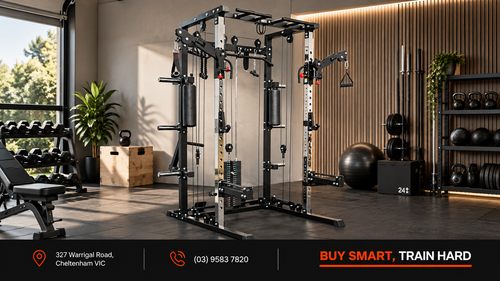
An all-in-one trainer combines a power rack or half rack with dual adjustable cable stacks, and often a guided Smith bar track, pull-up bar and dip bars, in a single footprint. This is the most versatile of the three types, since it supports free barbell work, guided Smith machine movements and independent cable exercises from one frame.
It is also the heaviest, largest and most expensive option of the three, which makes sense given it is designed to replace several separate pieces of equipment.
Smith Machine
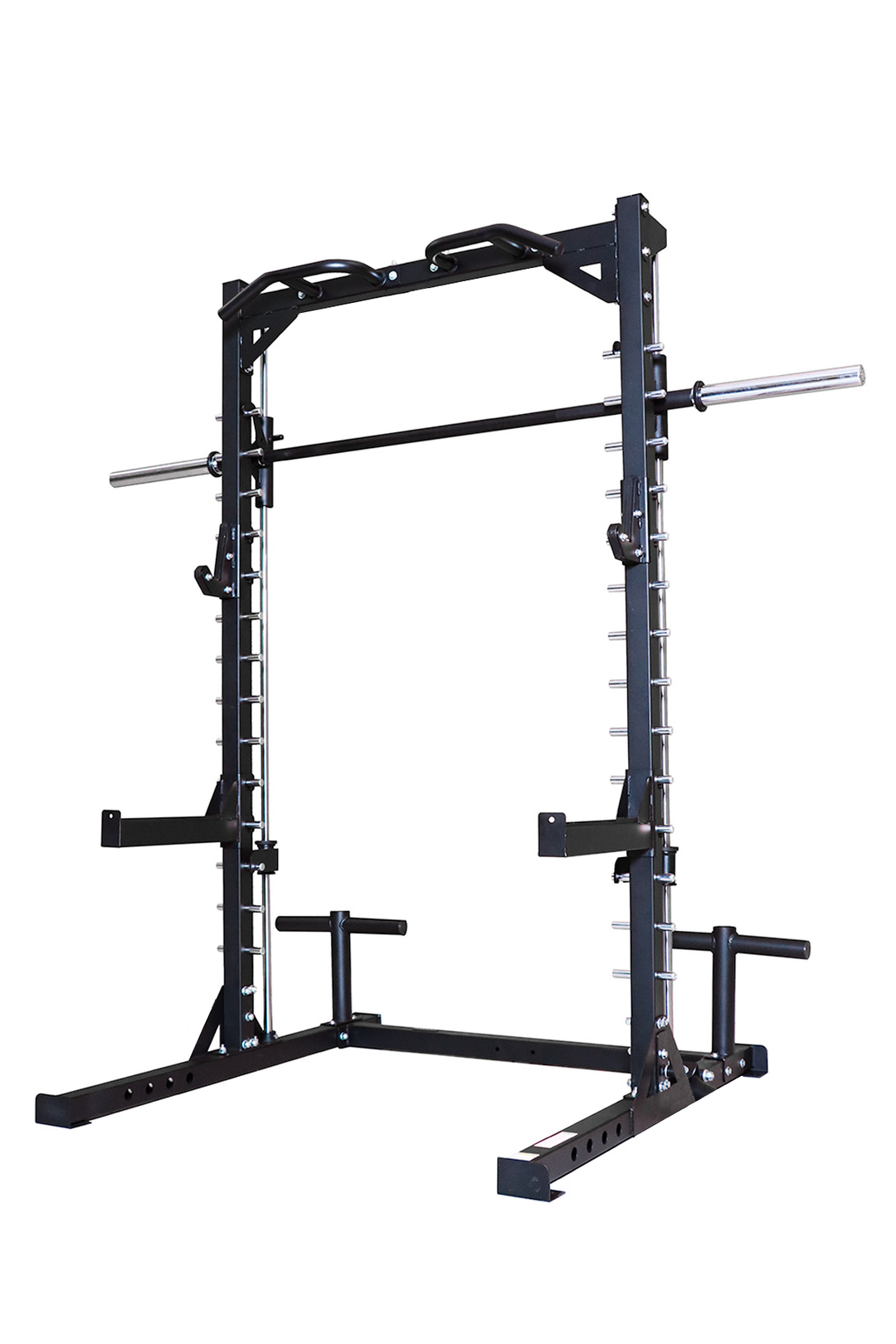
A Smith machine fixes a barbell inside a steel frame so it only travels vertically along guided rails, with safety hooks that catch the bar at any point. This makes heavy squats, presses and lifts safe to perform without a spotter, which is the main reason solo lifters choose one.
The fixed vertical path is also its main limitation, since it does not allow the slight forward and backward movement a free barbell naturally makes, and a standalone Smith machine does not include independent cable stations unless it is bought as part of a hybrid all-in-one design.

Single-Station Gyms: The Option Often Left Out of the Comparison
A single-station gym shares one weight stack across a small number of exercises rather than offering several independent stations. It is the smallest footprint option of the group, built for solo users who want guided strength training without the space or budget commitment of a multi-station or all-in-one setup.
Where it falls short is simultaneous use. Since there is only one stack, only one person can train on it at a time, and there is no upgrade path from a single-station frame to a multi-station one later, since the two use different structures entirely.
Matching the Type to Your Situation
Space and Footprint
Single-station and compact multi-station units take up the least floor space. All-in-one trainers take up the most, since the rack structure and dual cable stacks both need clearance.
A Smith machine sits in between, needing enough length for the guided rails plus space to load and unload the bar safely from both sides.
Budget
Multi-station and single-station gyms are generally the more affordable entry points. All-in-one trainers cost more because they are replacing several pieces of equipment in one frame, so the higher price reflects the amount of separate equipment you are not buying individually.
Solo Training vs Shared or Family Use
A multi-station gym with more than one station lets two people train different exercises at the same time. A Smith machine or single-station gym is built around one working area, so a second person waits their turn.
An all-in-one trainer sits in between, since its dual cable stacks can allow two people to work independently even though the Smith bar and rack are shared.
Guided Movement vs Free Weight Versatility
If you want a fixed, predictable path with no need to balance a bar, a multi-station gym or Smith machine suits that goal directly.
If you want the option to do free barbell work as well as guided and cable-based training, an all-in-one trainer is the only one of the three that offers all three training styles from a single footprint.

Common Misconceptions
-
Not all all-in-one trainers are the same. Some include a full Smith machine and power rack, others include only a half rack or omit the Smith bar entirely and function closer to a pure functional trainer. Always check what is actually included before assuming two "all-in-one" listings are equivalent.
-
A Smith machine is not just for beginners. Many experienced lifters use one deliberately for solo training or to manage fatigue safely on heavy days, not because they cannot handle a free bar.
-
A multipower machine is generally the same idea as a Smith machine. The terms are often used interchangeably in different markets, both describing a barbell guided along a fixed vertical track.
-
A functional trainer and a Smith machine are not interchangeable. A functional trainer is built around independent cable pulleys for pressing and pulling movements, while a Smith machine is built around a fixed barbell path. An all-in-one trainer is the category that combines both.
Where to Start Shopping by Type
Once you know which type fits your space, budget and training style, use this table to shortlist a starting point. This is the only section carrying product and collection links, kept in one place rather than scattered through the article.
|
If you want |
Start with |
|---|---|
|
A true multi-station gym with fixed stations |
|
|
The smallest footprint, single stack option |
|
|
A compact multi-station with a leg press |
|
|
A rack, cables and guided Smith bar in one frame |
|
|
A standalone Smith machine only |
|
|
Browsing every home gym option together |
Common Mistakes When Choosing Between Types
-
Assuming "all-in-one" always means the same features. Check whether a Smith bar, full rack, or half rack is actually included before comparing price between listings.
-
Buying an all-in-one trainer for space reasons. If floor space is the main constraint, a compact multi-station or single-station unit almost always has a smaller footprint than an all-in-one trainer.
-
Expecting a Smith machine to replace cable training. A standalone Smith machine covers guided barbell movements only, not the pulling and isolation exercises a cable station provides.
-
Underestimating shared household use. A single-station or Smith machine setup can become a bottleneck once more than one person in the household wants to train regularly.
Shop by Home Gym Type
Two examples from each category, plus a button to browse the full range.
Multi-Station Gym
BROWSE ALL MULTI-STATION HOME GYMS


Frequently Asked Questions
Q. What is the difference between a Smith machine and a multi-station gym?
A. A Smith machine guides a barbell along a fixed vertical track for squats, presses and lifts, while a multi-station gym uses cable and pulley stations for a wider range of pressing, pulling and isolation exercises.
Q. Can one machine really replace a full commercial gym?
A. A well-specced multi-station or functional trainer can cover most muscle groups for general strength training, but it will not fully replace a commercial gym's range of free weights, cardio equipment and specialty machines.
Q. Which is better for a family, a multi-station gym or an all-in-one trainer?
A. A multi-station gym is generally better for a family because separate stations let more than one person train at the same time, where an all-in-one trainer is built around a single set of pulleys.
Q. Do all-in-one trainers work for advanced lifters?
A. All-in-one functional trainers work for advanced lifters for cable-based accessory and isolation work, but most advanced lifters still pair one with a squat rack or free weights for heavy compound lifts.
Q. What is a single-station gym and who is it for?
A. A single-station gym has one weight stack shared across a small number of exercises and suits solo users with limited space or budget who do not need simultaneous multi-person training.
Q. Is an all-in-one home gym easier to maintain than a multi-station gym?
A. Yes, an all-in-one home gym generally has fewer cables and pulleys to inspect and maintain than a multi-station gym with several independent stations.
Q. Which type of home gym takes up the least floor space?
A. A single-station or all-in-one functional trainer takes up the least floor space, since it is built around one weight stack rather than the wider frame needed for multiple independent stations.
Q. Can I upgrade from a single-station to a multi-station gym later?
A. Generally no, since single-station and multi-station frames are different structures, so upgrading means replacing the unit rather than adding stations to an existing single-station frame.
Checkout more on Home Gym Collections.
Leave a comment